The total due tells you what to pay, but not why the number changed. To check a gas bill, work from the service dates and meter readings through the units used, rates, fees, and account balance. That order helps you tell a cold-weather increase from an estimated reading, a rate change, or a charge unrelated to gas use.
This is a straightforward paperwork check. You don't need to adjust the meter or any gas equipment.
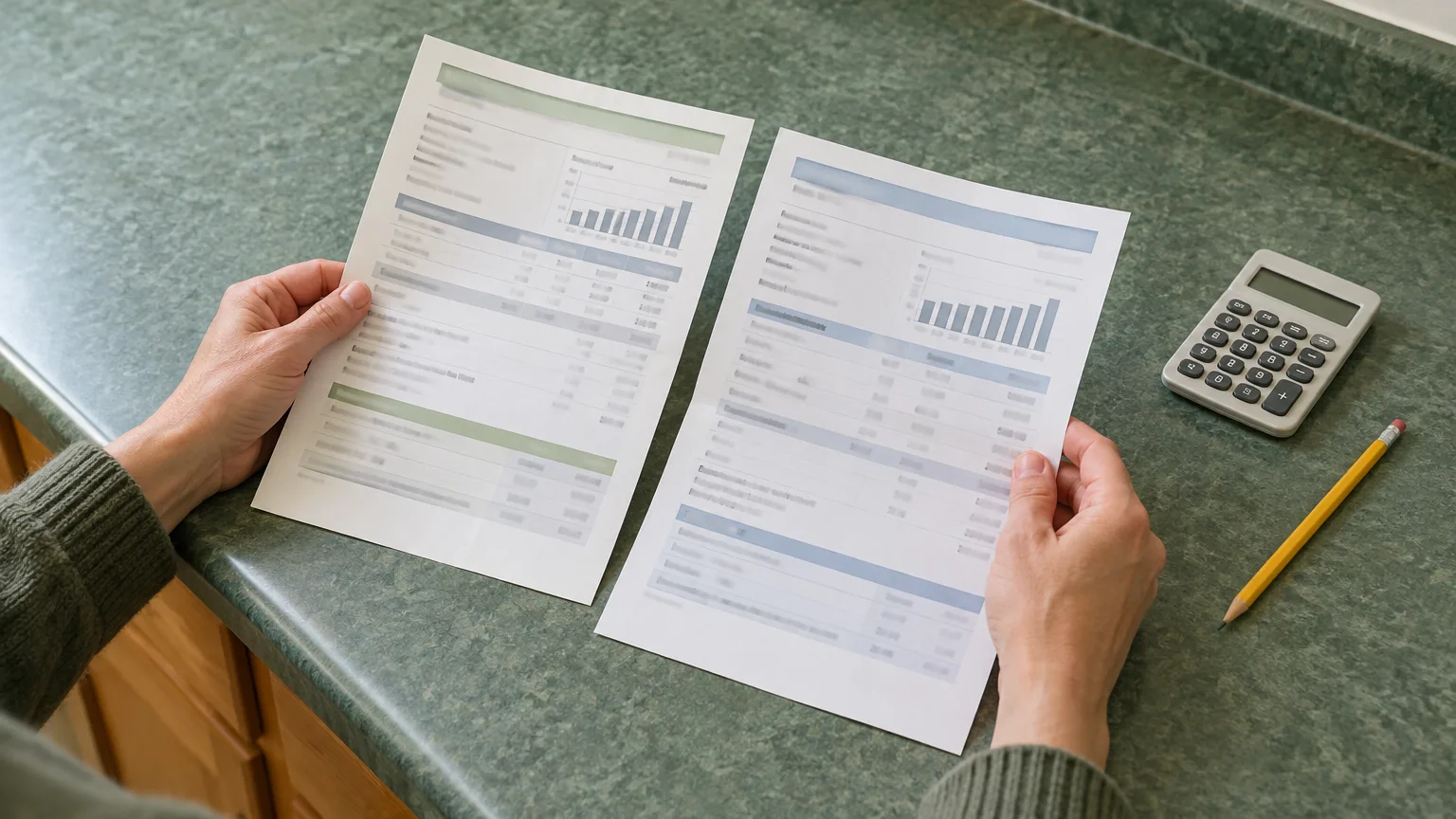
- Your gas bill and the previous bill
- A calculator or phone calculator
- Your supplier agreement, if you buy gas from a separate company
- Optional: a phone camera if you can safely view your meter
1. Check the account and billing period
Find the service address, account number, bill date, service dates, and number of days billed. Make sure the bill is for your home and covers the period you expect. A bill covering 35 days will often cost more than one covering 28 days, even if your daily use barely changed.
Next, separate current gas charges from the total amount due. The total can include an unpaid balance, a late fee, or a correction from an earlier bill. Check that your last payment appears as a credit. On a combined gas-and-electric bill, keep the two services separate while you review them; electricity charges use different units and rate structures.
A residential sample bill from Con Edison shows why this distinction matters: its billing summary includes payments and balances, while its service details show the readings and charges for the billing period.
2. Find out whether the readings are actual or estimated
Locate the previous and new meter readings, their dates, and any labels such as “actual,” “estimated,” or “customer supplied.” Check both readings, not just the new one. If last month's reading was estimated and this month's is actual, this bill may be catching up with gas you used earlier. A large catch-up charge does not, by itself, mean you used all that gas this month.
An estimated reading is a projection, not a measurement from the meter. Peoples Gas explains that differences between its estimated readings and actual use are accounted for when it obtains the next actual reading. Look at the prior bill as well: repeated estimates are a stronger reason to arrange a reading than a single estimate that closely matches your usual use.
Don't confuse an estimated meter reading with budget billing. Budget billing spreads expected costs into more even payments; the reading type tells you whether the billed usage was measured or projected. If you use budget billing, check both the amount due under the plan and the underlying gas charges.
3. Compare the bill with your meter, if you can reach it safely
First match the meter number on the bill to the meter serving your home. Then record the display and the date you checked it. You don't need to open, reset, disconnect, or otherwise handle the meter.
If you have a dial meter, read the numbered dials from left to right. When a hand falls between two numbers, use the lower number; between 9 and 0, use 9. If a hand appears exactly on a number, the next dial determines whether it has passed that number. Digital meters are generally read from left to right, but follow your utility's directions for which digits to report. National Grid's dial and digital meter examples show the difference.
A reading taken today will normally be higher than the reading shown for an earlier billing date. It isn't an exact check of last month's usage, but a photo and date can help your utility investigate a reading that looks wrong.
If you smell gas, hear hissing, or suspect a leak while approaching the meter, stop the bill check. Leave the area immediately. Don't operate switches, appliances, or a phone nearby; once you're safely away, call 911 or your gas utility's emergency number. Don't return until emergency personnel say it's safe. Con Edison's gas-leak guidance makes clear that a suspected leak is an emergency, not a meter-reading problem to troubleshoot yourself.
4. Recalculate the gas usage
Subtract the previous billed reading from the new billed reading. If the bill shows 1,200 followed by 1,250, the difference is 50 meter units. Before comparing that result with the usage charge, identify what those units mean. Some bills show gas volume in Ccf; others convert the volume into therms.
A Ccf is 100 cubic feet, while a therm is 100,000 British thermal units of heat energy. The units are related, but they are not interchangeable. A bill that starts with Ccf may apply a heat-content or billing factor before showing chargeable therms. Use the factor printed on your bill rather than assuming that 50 Ccf equals 50 therms; gas heat content can vary by place and over time.
For a simple illustration, 50 Ccf multiplied by a hypothetical factor of 1.04 gives 52 therms. Your utility's calculation may include other adjustments or rounding, so compare your result with the bill's stated usage before assuming a small difference is an error. A billing factor can account for more than heat content, depending on the utility.
5. Check each usage rate and fixed charge
Start with the charge for the gas itself, often called supply, commodity, or gas cost. Then find the delivery or distribution charge for moving gas through the local system. Some bills show each as a price per therm; others have several usage-based lines. Don't mistake the supply price for the full price of using one more therm if delivery is charged separately.
For example, at hypothetical rates of $0.85 per therm for supply and $0.70 per therm for delivery, 52 therms would cost $44.20 for supply and $36.40 for usage-based delivery. Add a hypothetical $18 customer charge and the subtotal is $98.60 before taxes, other fees, or credits. These numbers illustrate the arithmetic, not rates you should expect to pay.
Check the rate and quantity on each line, rather than dividing the whole bill by its therms. A basic or customer charge can apply even in a low-use month; Peoples Gas distinguishes its fixed customer charge from a distribution charge that varies with therms used. Your bill may also split usage into tiers or show different rates for parts of the billing period. If it does, calculate each line using the quantity and rate printed beside it.
Finally, identify who supplies your gas. In places that allow a separate supplier, the local utility may still deliver the gas, and the supplier's charge may appear on the same bill or a separate one. Con Edison describes both single-bill and separate-bill arrangements. If a supplier name or price has changed, check your agreement's rate, term, and renewal provisions before treating the change as a meter problem.
6. Inspect fees, adjustments, and credits
Read the smaller lines even when the usage math checks out. Look for taxes, surcharges, rate adjustments, deposits, late fees, and corrections to earlier bills. The label alone may not explain a charge: a “monthly adjustment” might change with the utility's rate rules, while a “prior-period adjustment” may correct a specific earlier bill. Check the bill's definitions or your utility's rate explanation before deciding a line is improper.
Also look for charges from companies other than your gas supplier or delivery utility. For example, SoCalGas notes that it may bill for other companies' energy-related or home-safety products and services. If you don't recognize a service, ask who authorized it, what period it covers, and how to dispute or cancel it. Don't assume every unfamiliar line is a government fee.
7. Compare usage with a fair reference period
Compare therms, not just dollars. Divide the billed therms by the number of service days to get average daily use, then compare that figure with a similar period last year or a recent bill with similar weather. If the therms are steady but the cost rises, focus on rates and fees. If therms jump, focus on reading status, the length of the period, heating demand, and changes at home.
A graph can help, but it can also hide an important difference between months. Check its scale, units, and missing context before judging a tall bar; note whether it shows dollars, total therms, or daily use. If your home uses gas for heat, a cold spell can matter far more than a small change in cooking habits.
If the increase still makes no sense, don't try to diagnose a gas appliance or pipe from the bill alone. The bill can show that measured use rose; it cannot identify the cause.
8. Ask the utility to explain any discrepancy
Keep the two bills, your calculations, and any dated meter photo together. Contact the company responsible for the disputed line: the delivery utility for meter readings and its charges, or the named supplier for its price and contract terms. Ask for the reading dates and types, the calculation behind the billed therms, and an explanation of any correction or unexpected fee. If your bill was estimated, ask how to submit a reading or arrange an actual one, and when any resulting adjustment would appear.
If the meter number is wrong, the arithmetic cannot be reconciled, or an actual reading appears inconsistent with the meter, request a billing investigation. If the measured usage remains unusually high after the billing details are checked, ask your utility what further checks it offers. Leave suspected equipment faults and all gas-line work to qualified utility personnel or a licensed gas professional: a bill review cannot establish that a gas system is safe.
How to tell the check worked
You should be able to explain the amount due in two parts: what happened to your account balance, and how this period's gas charges were built from readings, billable usage, rates, fixed charges, and other lines. If you still can't account for a difference, write down the exact line or reading in question and request an explanation rather than accepting a vague answer about “higher usage.”