A difficult reading can feel clear after someone explains it. That feeling isn’t the same as being able to explain the passage yourself. AI is useful here as a practice partner: it can help you untangle one sentence, ask you questions, and challenge an answer. The assigned text still decides what counts as a sound reading. The Institute of Education Sciences cautions that general-purpose AI can hinder learning when it does the thinking for students.
It’s easy to run, though checking your answers takes more care than writing the prompts. It works for a dense textbook section, a journal article, or a few pages of a novel. If the assignment asks for your own interpretation, use AI to test your reasoning—not to supply the interpretation you turn in.
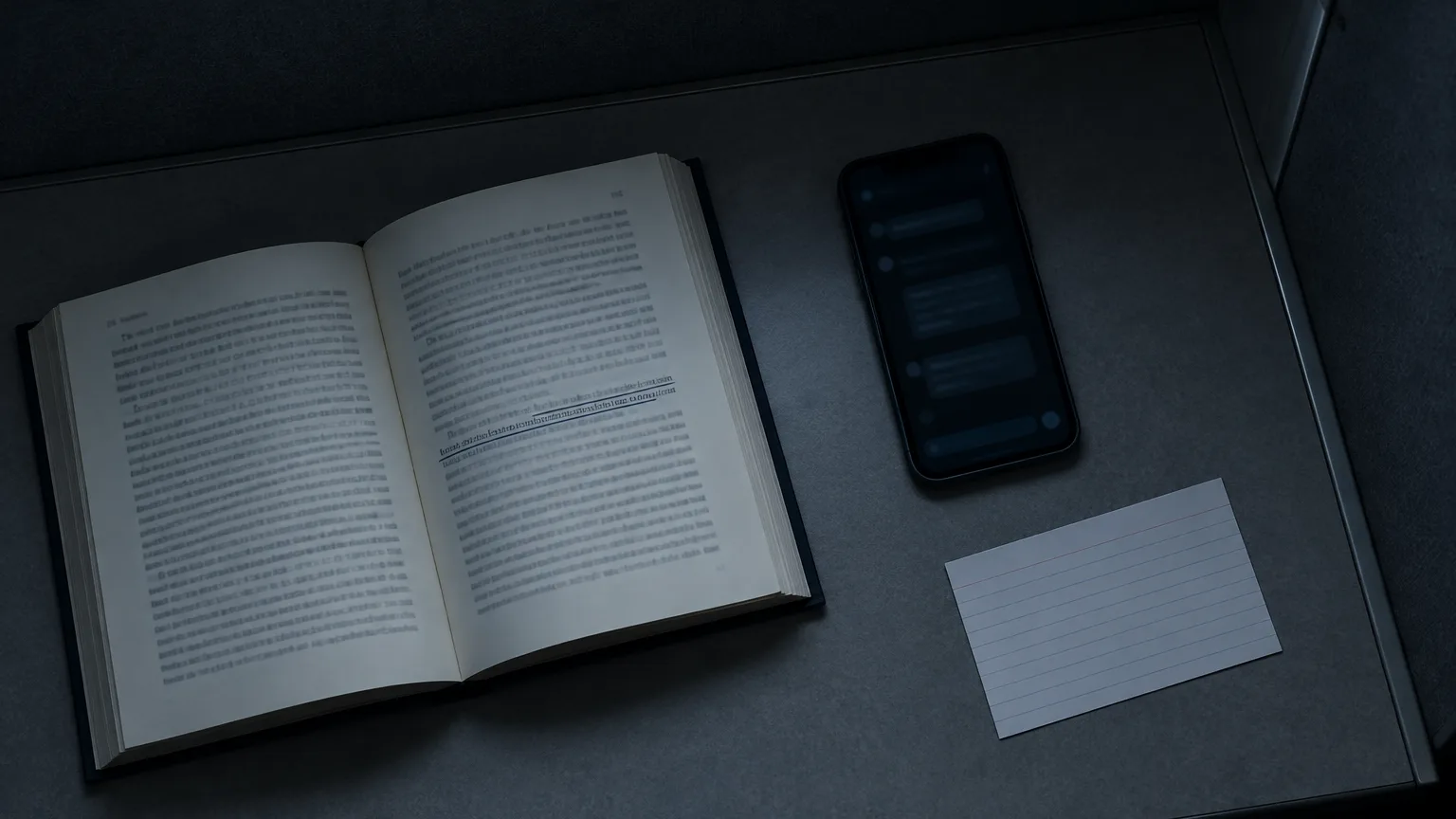
You’ll need:
- The assigned text, with page or paragraph numbers if available
- A notebook or document for your own answers
- An AI chat tool permitted by your instructor or school
- Your course instructions, including any rules on AI use or sharing readings
A passage-first routine
1. Mark the point where you lose the thread
Read the passage once without AI. Mark the first sentence, term, or shift in argument that you can’t explain. Beside it, write what you do understand and one question. “I understand the result, but not why the author calls it a limitation” gives you a much better starting point than “Explain this chapter.”
Keep the surrounding paragraph in view. A sentence that looks obscure on its own may depend on a definition two paragraphs earlier or a contrast signaled by however. If you’re stuck across several pages, choose one short section to work through first. You can repeat the routine for the next section rather than asking for a single explanation of everything.
This pause is part of reading, not a failure of it. The What Works Clearinghouse recommends noticing where a text stops making sense and taking action, including rereading and asking questions.
2. Select a passage you’re allowed to share
Check the assignment and your school’s AI policy before entering course material into a tool. If copying the reading isn’t allowed, type a short question in your own words instead: “In paragraph 4, what does the author mean by ‘selection bias’?” You can still use the routine; you’ll just need to check the reply against the text yourself.
Don’t upload classmates’ work, private feedback, grades, identifying details, or an entire course packet to an unapproved tool. For classroom use, the U.S. Department of Education advises teachers to check whether an online application is approved by their school or district.
When sharing is permitted, provide only the section needed to answer your question. Include a little context and the author’s wording where it matters. If the passage depends on a chart, footnote, or earlier definition, have that material beside you; an explanation based on the paragraph alone may miss it.
3. Ask for one clarification, not a replacement reading
Tell the AI exactly what is confusing you and how narrow its answer should be. For example:
In the passage below, explain the sentence beginning “Although the results…” in plain language. Identify what the author is contrasting. Use only this passage. If you need context I haven’t provided, tell me what is missing rather than guessing.
That last instruction is useful, but it isn’t a guarantee. The AI may still add background, smooth over an awkward distinction, or answer a slightly different question. Your aim is a short explanation you can inspect, not a polished summary that makes the original seem unnecessary.
If the difficulty is a term, ask how the author uses it here. If it’s a long sentence, ask for its main claim and the role of each clause. If two sections appear to disagree, ask the AI to state each claim separately before proposing a connection. These smaller tasks give you something specific to check.
4. Check the explanation against the assigned text
Put the AI’s answer next to the passage. For each important claim, find the words, figure, or context that supports it. Pay particular attention to qualifiers: some is not all; may cause is not causes; in this sample is not in everyone. In a novel or essay, check whether the explanation presents one possible interpretation as if it were the author’s stated meaning.
A useful follow-up is: “Which sentence in the passage supports that claim? Separate what the text states from what you inferred.” Then inspect the cited sentence yourself. A quotation supplied by AI is not proof that it appears in your copy.
The caution is practical, not theoretical. The National Institute of Standards and Technology notes that generative AI can confidently produce false content, including misleading explanations or citations. If the reply adds a fact that the passage doesn’t contain, label it outside context rather than treating it as part of the assignment. If it changes the author’s claim, set it aside and reread.
5. Ask for questions that test the passage
Once you have checked the clarification, turn the chat into a quiz. Ask for a few questions with different demands, and keep the answers hidden:
Write four short-answer questions about this passage: one on its main claim, one on a key detail, one asking me to connect two ideas, and one asking what the passage does not establish. Don’t show answers until I respond. Base every question on the text provided.
The “does not establish” question is especially good for catching an overly broad reading. A passage may report that a method worked in one study without showing that it works in every setting. If the AI writes a question whose answer requires information beyond the assigned text, reject or rewrite it.
Quizzing is worth the effort because it asks you to retrieve and use an idea rather than simply recognize an explanation that sounds familiar. The What Works Clearinghouse recommends quizzes that revisit key content and questions that call for deeper explanation.
6. Answer without looking at the AI’s explanation
Close or scroll past the explanation. Write each answer in your own words, then note the sentence, paragraph, or page that led you there. For an interpretation question, distinguish evidence from inference: “The author says X in paragraph 3; I take that to suggest Y because…”
Resist the urge to ask for a hint as soon as you hesitate. Try a reread first. If you still can’t answer, write down the precise gap: “I can name the two causes but can’t explain why the author ranks one above the other.” That is a useful result. It tells you what to ask about next.
Don’t mistake a right-sounding answer for a complete one. If the question asks why a claim follows, merely repeating the claim hasn’t shown that you understand the reasoning.
7. Compare the feedback with the passage
Now ask the AI to assess your answers, but give it a limited job:
Compare my answers with the supplied passage. For each one, identify what I got right, what I missed, and the exact part of the passage I should check. Don’t mark an answer wrong solely because it uses different wording.
Check that feedback as carefully as you checked the first explanation. AI can accept an unsupported answer or criticize a sound one because it expected different phrasing. If it identifies a missed detail, locate that detail. If it claims your interpretation is wrong, ask what in the text rules it out. When the passage allows more than one reasonable reading, a justified answer matters more than a match to the AI’s preferred answer.
Correct your notes using the assigned reading, not by copying the AI’s model response. Keep the distinction between “the author says,” “the evidence suggests,” and “I think.” It will help when you discuss the text in class or write about it later.
8. Retry the hardest idea from memory
Set the chat aside for a few minutes, then explain the difficult point in two or three sentences without looking at its reply. Return to the passage to check your explanation. If you can identify the claim, show where it comes from, and preserve its limits, you’ve done more than follow someone else’s summary.
If you can’t, shrink the task. Explain one paragraph, one contrast, or one use of a term. Students reading in a new language may also find it helpful to build this sort of short, repeatable practice into a daily language-learning routine. For a research paper, it may help to separate the authors’ broad question from their specific hypothesis.
How to tell it worked—and when to ask a person
You’ve understood the passage well enough to move on when you can explain its main point without the AI’s wording, point to the text behind your explanation, and say what the passage leaves uncertain. You should also be able to answer at least one question that asks you to connect ideas, not just repeat a definition.
If that test fails, check the likely cause. A wrong AI answer calls for a fresh reading of the source, not a longer argument with the chatbot. A question you can answer only by looking at the AI’s response calls for another attempt from memory. If a chart, earlier chapter, or technical term is missing, get that context before trying again.
Ask your instructor, a tutor, or a subject librarian when the passage remains unclear after careful rereading, when the assignment turns on a disputed interpretation, or when you can’t judge whether an explanation fits the field’s methods. A person who knows the course can clarify what the author means and what your assignment expects. AI can help you form a better question for them; it shouldn’t be the final authority on the reading.