A sleep score can make an ordinary morning feel like a test result. You wake up feeling fine, check your watch, see a low number, and start searching for what went wrong. Or you feel exhausted after a supposedly excellent night and wonder if you should trust the device over your own body.
I wouldn’t give a sleep score that much authority. Sleep trackers can be useful, especially for spotting a drifting bedtime or a stretch of short nights. But they estimate sleep from signals collected at the wrist or finger; they don’t examine you, establish why you’re tired, or tell you what your sleep should look like every night. Their best job is to help you notice a pattern worth acting on—not to grade your health each morning.
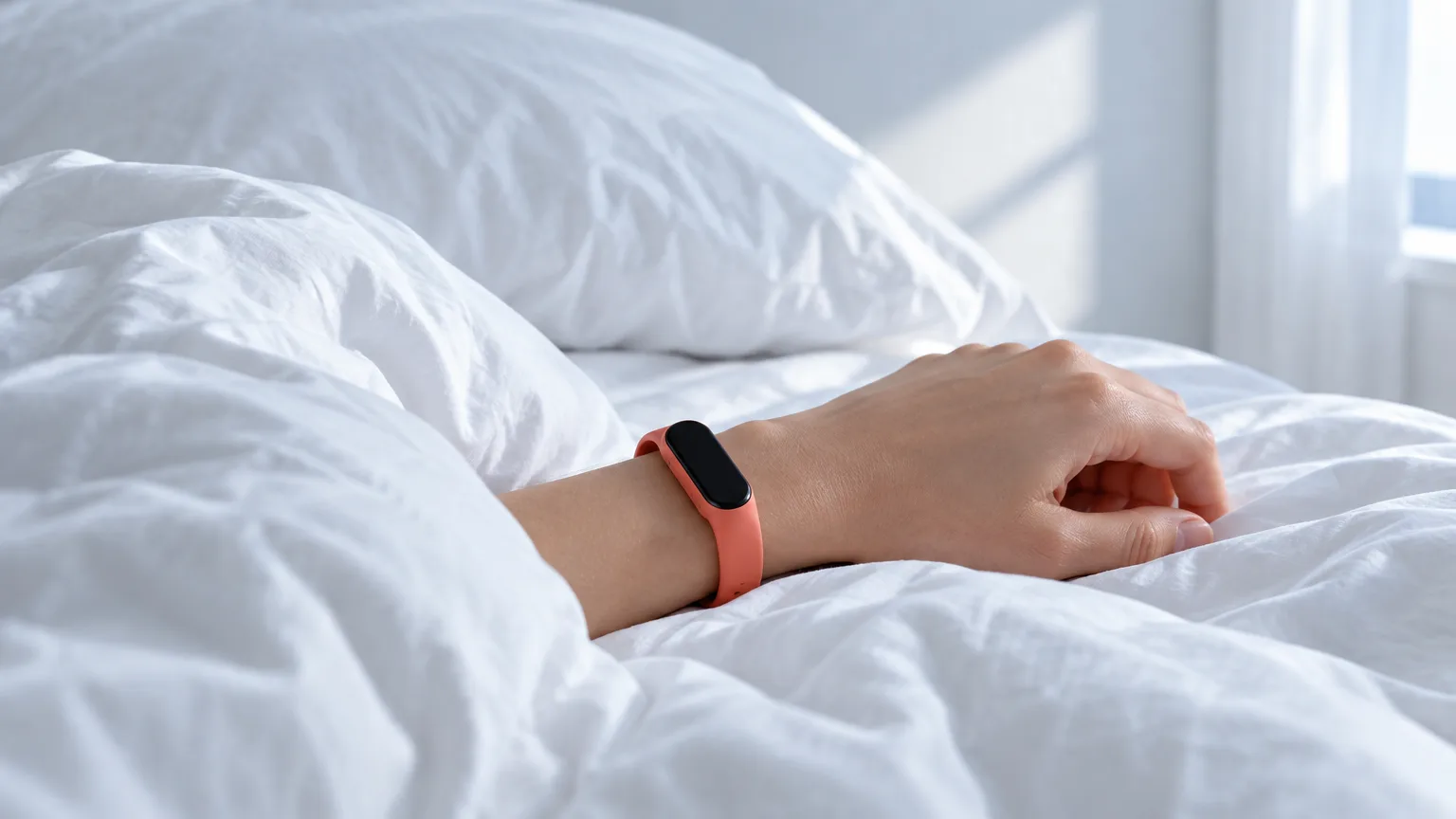
A precise-looking sleep score is still an estimate
A watch can record movement and, depending on the device, signals such as changes in pulse. Its software then estimates when you were asleep and how that time was divided among sleep stages. A clinical sleep study uses additional measurements, including brain waves, eye movements, muscle activity, and breathing. Those differences matter most when an app presents “deep sleep” or “REM sleep” as if it had measured them directly.
In a 2025 comparison of six wearables with laboratory sleep studies, every device identified more than 90% of periods when participants were asleep. Identifying wakefulness was harder: the devices correctly identified roughly 29% to 52% of awake periods. Most also differed significantly from the sleep study on measures including total sleep time or time awake after falling asleep. That doesn’t make the devices useless. It does mean a chart showing a brief awakening—or no awakening—may not settle what happened.
Accuracy also depends on which measurement you mean. A study of 53 young adults found that four of five consumer devices estimated total sleep time comparably to research-grade movement tracking. Yet the devices showed biases in estimates of wake time and sleep stages. “Is this tracker accurate?” is too broad a question. “Can it help me see that I’ve been going to bed an hour later?” is much more useful.
Then there’s the score itself. The American Academy of Sleep Medicine describes sleep scores as product-specific calculations drawn from sensor data, questionnaires, or both. A score of 82 is not a clinical finding, and it isn’t a unit you can compare cleanly across brands. Even within one app, it compresses several estimates into a single number and hides the question that matters: What, if anything, should I do differently?
A watch alert can raise a medical question, not answer it
Sleep apnea features are the strongest argument against dismissing wearables outright. A device that flags a possible breathing problem could prompt someone to seek care when they otherwise wouldn’t. That is a real benefit, and it deserves a more careful response than “smartwatches can’t diagnose anything.”
The distinction is between an alert and a diagnosis. The FDA-cleared Apple Watch sleep apnea notification feature looks for patterns suggestive of moderate to severe sleep apnea in eligible adults who haven’t previously been diagnosed. Its stated use does not include diagnosing or treating sleep apnea, and no notification does not mean a person is free of it. The Samsung Sleep Apnea Feature v2.0 likewise assesses signs of moderate to severe sleep apnea on compatible devices; its intended use says it should not replace diagnosis and treatment by a qualified clinician.
So take an alert seriously, but don’t treat it as a verdict. Share it with a healthcare professional along with what you or a bed partner have noticed. And don’t wait for an alert if you have symptoms. Loud snoring, breathing that stops and starts, gasping during sleep, and daytime sleepiness are reasons to discuss possible sleep apnea even when your app shows reassuring numbers.
The same limit applies beyond apnea. A tracker’s restless-night graph doesn’t diagnose insomnia, and a high score doesn’t explain persistent fatigue. A clinician starts with your symptoms and sleep history, then decides whether testing would help. Sleep studies can help diagnose sleep disorders, but the right test depends on the problem; not every sleep complaint calls for a night in a laboratory.
The strongest case for tracking is the long view
It’s fair to ask: if trackers are imperfect, why use one at all? Because an imperfect record gathered over weeks can reveal something a single night cannot. You may discover that your sleep window shrinks every time an early shift starts, or that “catching up” on the weekend leaves your bedtime moving later. You don’t need exact REM minutes to see either pattern.
That’s the case for keeping the device—provided you give it a modest assignment. Use it to ask questions about your routine, not to deliver answers about your physiology. A sensible approach looks like this:
- Look at trends over a couple of weeks rather than one night’s score. Start with bedtime, wake time, and the amount of time you’ve allowed for sleep.
- Add context the tracker can’t know. Note schedule changes, overnight disruptions, illness, or anything else that made a night unusual.
- Record how you feel during the day. Are you alert at work? Do you struggle to stay awake? Do you wake feeling rested? Those observations belong beside the graph, not beneath it.
- Change one practical thing at a time, then see whether the pattern—and your daytime functioning—improves.
Suppose your watch suggests you sleep less on nights before an early commute. The useful response isn’t to chase a higher deep-sleep percentage. It’s to check whether your schedule leaves enough time in bed and whether you can protect an earlier wind-down. If changing hours is the obstacle, a bedtime routine that works when your schedule changes may be more useful than another night of stage data.
You can also do this without a wearable. A brief sleep diary can capture when you went to bed, when you got up, how you slept, and how you felt the next day. For someone seeking care, the National Heart, Lung, and Blood Institute notes that a sleep diary can help a provider evaluate a problem. The point is not to produce a flawless record. It’s to bring a clearer account of your experience.
When the score starts making sleep worse
The score can become a problem when it changes your behavior in the wrong direction. If a low number makes you anxious before the day begins, or you stay in bed long after you’re awake to improve the app’s total, tracking has stopped serving you.
Sleep clinicians described this pattern in a 2017 report of three patients, using the term orthosomnia for a preoccupation with perfecting wearable sleep data. Three cases don’t tell us how common the problem is, and a low score does not cause insomnia by itself. But they illustrate a mistake worth avoiding: treating the device’s estimate as more important than your symptoms, habits, and response to care.
Try hiding the score, checking it less often, or taking a break from tracking if it leaves you more worried than informed. If worry about sleep has become persistent, bring that up when you seek help. Tracking isn’t a treatment for chronic insomnia; cognitive behavioral therapy for insomnia is usually recommended as a first treatment option.
That distinction matters with other health apps, too. A mental health app can support therapy without replacing it; sleep data can support a conversation about care without becoming the care itself.
Let symptoms outrank the screen
A good night on an app is not a reason to ignore repeated gasping, a partner’s report that your breathing stops, or sleepiness that interferes with daily life. A bad night on an app is not, by itself, evidence of disease. In either case, bring the pattern and your symptoms to a healthcare professional rather than trying to settle the question with a better score.
Keep the tracker if it helps you make room for sleep and recognize changes in your routine. Put it aside if it turns rest into a performance review. The goal is not to produce a number your watch approves of. It’s to sleep well enough to live your day—and to get appropriate care when you don’t.
Disclaimer
This article provides general health information and is not a substitute for advice from a qualified healthcare professional.