Braces, bridges and implants change the route floss takes, not the reason for using it. The aim is to clean the tooth surfaces and gumline a toothbrush misses, plus the spaces beneath fixed dental work where food can collect. The American Dental Association recommends cleaning between teeth once a day; brushing alone cannot reach every contact between teeth.
This is a manageable home-care job, though threading floss around braces or under a bridge takes practice. Allow roughly five to 10 minutes at first. You only need the tools that fit your dental work:
- A mirror and good light
- Regular floss, or floss with a stiff end
- A floss threader—a small plastic loop that guides ordinary floss past a wire or under a bridge
- An interdental brush sized for an open space, if your dental team recommends one
- An optional water flosser
- A soft toothbrush and fluoride toothpaste
If you’ve recently had an implant placed or other oral surgery, follow your dentist’s instructions for the healing area rather than starting this routine there on your own.
Clean around braces
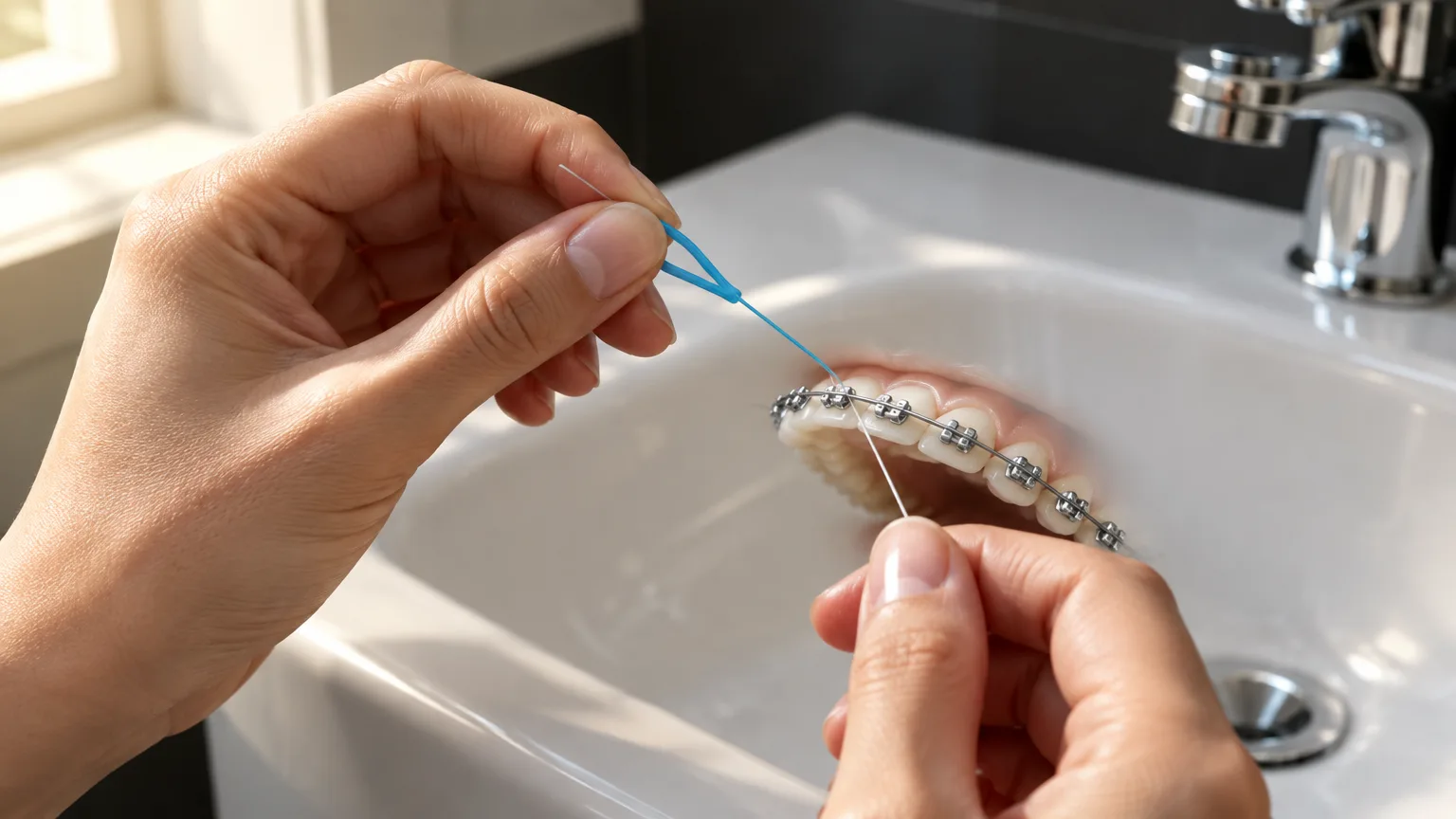
The archwire blocks the usual path from the biting edge of the teeth down toward the gums. Threading floss under that wire lets you clean the sides of the teeth as you normally would. Harvard School of Dental Medicine’s orthodontic instructions recommend a threader when needed, followed by C-shaped flossing against each tooth.
Thread the floss beneath the archwire. Pass a length of floss through the loop of a threader. Guide the threader through the space between the wire and the teeth, then pull enough floss through to hold it comfortably. Keep the strand clear of brackets and any small wires attached to them.
Clean both sides of one tooth gap. Ease the floss between the teeth with a gentle back-and-forth motion. Curve it around one tooth in a C shape and move it up and down along the side, including just below the gumline. Curve it around the neighboring tooth and repeat. Don’t snap the floss against the gum; cleaning should not require force.
Move to the next gap. Withdraw the floss carefully, rethread it under the archwire at the next space, and work around the mouth. An orthodontic flosser designed to fit beneath the wire may be easier to handle, but check that its shape actually lets you reach the gumline on both teeth.
Clear food around the brackets. If you have a small interdental brush, guide its bristles gently around brackets and beneath the archwire where there’s room. This cleans hardware that string floss may miss; it doesn’t take the place of cleaning between two tightly touching teeth. Don’t push a brush through a space that’s too narrow, and stop if its wire catches on a bracket. The American Association of Orthodontists describes interdental brushes as useful around brackets and under wires.
Clean under a fixed bridge
A fixed bridge has a false tooth, called a pontic, joined to its supports. You cannot drop floss from above between those connected parts. The easily missed surface is beneath the false tooth, along the gum, and beside the supporting teeth. A floss threader can carry floss under that area.
Pass floss beneath the false tooth. Feed regular floss through a threader, or use floss made with a stiff leading end. From the cheek side, guide it through an opening beneath the bridge toward the tongue side. Do not try to force floss down through a joined crown.
Sweep the underside of the bridge. Hold the floss against the underside of the false tooth and move it gently along the gumline. Carry it toward each supporting tooth to clean where the bridge meets those teeth. Slide the floss out from beneath the bridge when you’re done rather than yanking it upward against the restoration. The ADA’s bridge guidance notes that a fixed bridge stays in place for cleaning, so reaching this underside matters.
Clean the other reachable contacts. Floss between the bridge and any adjacent natural teeth as you would elsewhere: curve the strand around each tooth and move it gently along the side. If there’s a wider opening beneath your bridge, your hygienist may suggest an interdental brush instead of, or in addition to, floss for that particular space. The right tool depends on the shape of the bridge and the room beneath it.
A temporary bridge may need different handling, especially where floss could catch an edge. Ask the dentist who placed it to show you how to clean it without dislodging it.
Clean around an implant crown or implant-supported bridge
An implant crown can usually be cleaned between its neighboring teeth much like a natural tooth. Larger implant-supported restorations may have an underside that needs a different route. The University of Illinois Chicago College of Dentistry’s implant guide advises regular brushing and flossing, with special floss or other aids when the restoration calls for them.
Floss beside a single implant crown. Guide floss gently through each contact beside the crown. Move it along the crown and the neighboring tooth surfaces without snapping it into the gum or trying to force it deep beneath the gumline. If floss repeatedly shreds or catches at the same spot, stop forcing it and have your dentist check the restoration.
Clean beneath a larger implant restoration as instructed. If you have an implant-supported bridge or fixed full-arch set of teeth, ask your dental team to identify each opening you should clean and demonstrate how to reach it. A threader, suitable floss, an interdental cleaner or a water flosser may be part of that plan; don’t assume a single implant crown and a full-arch restoration have the same cleaning route. The American College of Prosthodontists recommends teaching patients the cleaning skills their full-arch restoration requires.
Use an implant-safe brush where one fits. An interdental brush can help in an open space around implant work, but size and construction matter. The ADA notes that brushes designed for implants have coated wire to avoid scratching implant surfaces. Choose the size your dentist or hygienist recommends, and never wedge a brush into a tight contact.
Pay attention to the gum around an implant even if the replacement tooth looks clean. Redness, tenderness or bleeding can be signs of inflammation around an implant and deserve a dental assessment if they persist.
Add a water flosser if it helps you reach missed spots
A water flosser can make cleaning around braces or a fixed bridge easier, particularly if threading floss is difficult. ADA-accepted water flossers have been evaluated for plaque removal and gingivitis reduction. Water can help flush an awkward space, but if you cannot tell whether you are cleaning beneath a bridge or implant restoration, ask your hygienist to check your technique rather than relying on the spray alone.
Trace the gumline with the water flosser. Fill the reservoir as its instructions direct, place the tip in your mouth, and lean over the sink before switching it on. Start at a low, comfortable pressure; move along the gumline, pausing between teeth and aiming around brackets or beneath reachable bridgework. Waterpik’s instructions recommend starting low and increasing pressure gradually. Do not use a powerful stream to try to dislodge something stuck under a restoration.
Brush every tooth and restoration. Use a soft brush and fluoride toothpaste, paying attention to the gumline, both sides of brackets, and the edges of crowns and bridges. Cleaning between teeth is an addition to brushing, not a replacement for it. You can brush before or after flossing; thorough cleaning matters more than the order.
Check your work—and know when to ask for help
Afterward, look for food still caught around brackets or beneath bridgework. Floss should pass through the intended spaces without needing to be forced, and cleaning should not leave you with sharp pain. You cannot judge plaque removal by sight alone, so ask your hygienist to check the areas you find hardest to reach at your next visit.
If a spot keeps trapping food, a brush will not fit, or you cannot get floss beneath a bridge, don’t probe with a pin or another sharp object. Have a dentist or hygienist demonstrate the route and check whether the restoration itself needs attention. They can also tell you which brush size or flosser tip suits your mouth. A loose bridge, crown or implant restoration needs professional evaluation, not harder cleaning.
Arrange a dental visit if bleeding keeps recurring, gums remain swollen, floss repeatedly catches, or you develop pain. If pain is severe, swelling is spreading, or bleeding will not stop, seek prompt care; these signs may call for urgent dental attention. Floss can remove debris, but it cannot fix a damaged restoration or treat an infection.
Disclaimer
This is general dental-care information, not a substitute for instructions from your dentist or orthodontist, especially after surgery or for complex implant work.