A topic such as “Does technology improve learning?” is too broad to test. It names no students, no kind of technology, and no outcome. Turn it into a question about one practice in one setting, and you can make a prediction that evidence could support or challenge.
This is a planning job, not a data-collection job. Checking the literature and arranging access to data can take time. The steps are manageable for a student or educator; designing a study that can support a strong claim of cause and effect is harder.
You’ll need:
- A broad topic or claim you want to investigate
- Access to relevant research, such as a library database or ERIC
- A description of the students and setting you can realistically study
- A possible measure of learning or behavior
- A document or spreadsheet for drafting and revising your question
1. Pick one problem you want to understand
Start with a problem small enough to observe. “Students need to be more engaged” is a concern, but engagement could mean attending class, participating in discussion, completing work, or paying attention. Choose the part that matters for your study.
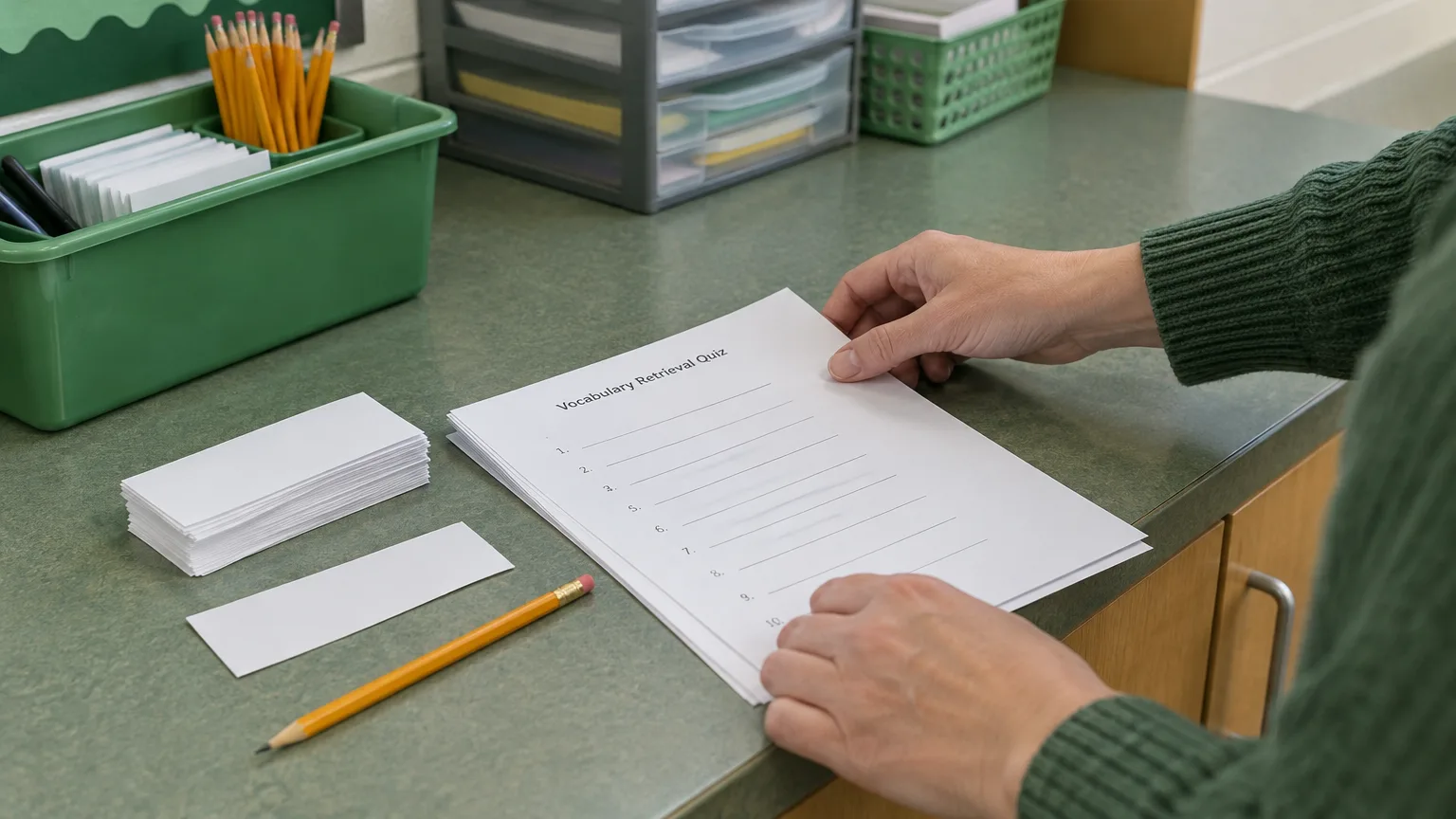
Suppose a seventh-grade teacher notices that students struggle to recall vocabulary from the previous week. That gives the project a clearer starting point than “How can technology improve education?” The teacher might investigate whether short retrieval quizzes—quizzes that ask students to recall words without looking them up—are related to later vocabulary performance.
Write the problem in one sentence, without proposing a solution yet: “Students in these seventh-grade classes often miss vocabulary items taught the previous week.” This keeps you from treating your preferred teaching method as the answer before you’ve framed the question.
2. Check what is already known
Search for studies on the specific practice, age group, and outcome. You’re not trying to prove your prediction by collecting favorable articles. You’re looking for a reason to study the relationship, ways other researchers measured it, and gaps your setting might help address.
For the vocabulary project, search separately for retrieval quizzes, middle-school vocabulary learning, and delayed assessments. Note whether prior studies compared quizzes with another activity, what students actually did, and when researchers measured recall. If “quizzing” meant five minutes of ungraded recall in one study and a graded weekly exam in another, those are not interchangeable interventions.
The Institute of Education Sciences’ guidance for education research calls for research questions or hypotheses to follow from a theoretical and empirical rationale, with a design and measures suited to the question. For a small project, a brief note on two or three relevant studies and what remains uncertain is a useful start.
3. Set the boundaries of the study
Decide who, where, and when. “Middle-school students” might be your intended population, but if you can study only two seventh-grade classes at one school, say that. A narrow question answered honestly is more useful than a sweeping question your data cannot address.
Give the practice a boundary, too. Instead of “regular quizzes,” specify something like “a five-minute, ungraded retrieval quiz at the start of each vocabulary lesson for four weeks.” Identify what those students would do otherwise. Perhaps the comparison is five minutes reviewing the word list. The comparison matters: a quiz versus no activity tests a different question from a quiz versus another form of practice.
At this point, make a short scope statement:
In two seventh-grade classes at one school, compare four weeks of five-minute retrieval quizzes with four weeks of word-list review, using the same vocabulary content.
That statement does not yet tell you whether the groups can be compared fairly. It does stop the project from expanding every time you encounter an interesting new idea.
4. Write a question your data could answer
Turn the scope statement into a question that names the practice, comparison, and outcome:
Among seventh-grade students in these classes, how do vocabulary scores one week after instruction differ between students assigned to five-minute retrieval quizzes and students assigned to five-minute word-list review over four weeks?
The wording matters. “How do scores differ?” leaves room for quiz scores to be higher, lower, or similar. “How much do quizzes improve scores?” assumes an improvement before you have evidence for one.
A research question asks what you want to find out. A hypothesis gives a proposed answer. You can write a useful question without yet knowing which direction to predict. You may also decide that a descriptive question—such as how students use feedback after a quiz—better suits your purpose. Don’t force every education project into an intervention test.
5. Define each variable so someone else could measure it
Now replace broad labels with observable definitions. In the vocabulary example, the practice is the explanatory variable: whether a student is assigned to retrieval quizzes or word-list review. The outcome variable is the score on a vocabulary assessment given one week after the relevant instruction.
Specify what the score represents. Is it the number of words correctly defined out of 20? Are responses scored using the same rubric by someone who does not know which activity each student received? Will every student take the assessment after the same interval? Those decisions affect what a score difference means.
“Learning” is not itself a measurement. Neither is “engagement.” A count of assignments submitted may be a reasonable measure of completion, but it does not capture every aspect of engagement. The IES standards on outcome measures emphasize defining the outcome of interest and choosing measures that are appropriate, reliable, and valid for it. In plain terms, the measure should consistently capture the thing you say you’re studying—not merely something convenient to count.
The same move works for claims far beyond vocabulary:
| Vague claim | Researchable question | Possible prediction |
|---|---|---|
| “Homework helps students.” | Among students in these sixth-grade math classes, how do end-of-unit fraction scores differ between those assigned two short practice sets per week and those assigned one? | Students assigned two practice sets will have higher end-of-unit fraction scores. |
| “Students prefer online lessons.” | In this introductory biology course, what proportion of students select a recorded explanation over a written explanation when both cover the same topic? | More than half of participating students will select the recorded explanation. |
| “Attendance affects achievement.” | Among students in this school’s ninth-grade cohort, is the number of days absent during the first semester associated with first-semester algebra grades? | Students with more absences will, on average, have lower algebra grades. |
Each prediction can be checked. The last example predicts an association, not that absences cause lower grades; other factors could affect both.
6. Match the question to a design you can carry out
Your design determines which claims the study might support. If you want to test whether a teaching practice causes a change, consider whether students or classes can be randomly assigned to the two activities while keeping instruction, assessment, and timing comparable. If random assignment is not possible, an existing-class comparison may still be informative, but differences between the classes could help explain the results.
For example, if one teacher gives the quizzes and another runs the review sessions, a score difference might reflect teacher differences as well as the activities. A before-and-after comparison within one class has a different problem: students may improve because of ordinary instruction or repeated exposure, even without the new practice. The What Works Clearinghouse standards for study designs examine issues such as group comparability, missing outcomes, and confounding when judging evidence about an intervention’s effects.
If you have only existing attendance and grade records, keep the question associational. If your real interest is why students respond differently to feedback, interviews or observations may fit better than a prediction about test scores. Revise the question to match the design you can actually use, not the design you wish you had.
7. State a prediction that could be wrong
Write the hypothesis as a direct answer to your question. For the vocabulary study:
After four weeks, seventh-grade students assigned to five-minute retrieval quizzes will score higher on a vocabulary assessment given one week after instruction than students assigned to five-minute word-list review.
This names the groups, practice, outcome, and timing. It also makes a falsifiable prediction: scores could be equal or lower in the quiz group. That possibility is essential. A statement such as “Retrieval practice benefits students in some way” can survive almost any result and gives you little guidance on what to measure.
You don’t need to invent a numerical target. Predict “at least five points higher” only if five points has a reasoned meaning for the assessment and your study is large enough to examine a difference of that size. If previous evidence does not justify a directional prediction, “scores will differ” is honest, though you should still say exactly which scores and groups you mean.
The IES standards for hypotheses and research design call for testable, falsifiable hypotheses and for findings to be reported whether they are positive, null, or negative. A result that challenges your prediction can still teach you something; rewriting the prediction after seeing the scores cannot serve as an advance test of it.
8. Check feasibility and record your plan
Before collecting data, ask whether you can deliver both activities as described, measure the outcome for enough students, and compare results at the planned time. Record the question, hypothesis, main outcome, group definitions, assessment, and intended comparison. Also decide what you will do if students miss a quiz or the final assessment. These choices are easier to make fairly before you know which choice favors the predicted result.
Protect students as you plan. Do not assume that being able to view grades as a teacher gives you permission to share identifiable records with an outside researcher. Under FERPA, sharing personally identifiable information from education records generally requires consent unless an applicable exception permits it; the requirements depend on how the study and data sharing are arranged. Ask the school or district about approval, data access, and whether an institutional review board must assess the project before recruiting students or collecting research data.
A modest, well-defined study may be possible without elaborate analysis. A causal study intended for publication, a project involving sensitive student information, or one requiring complex assignment and sample-size decisions is better planned with an education researcher or methods adviser. For access to student records and permissions, work with the school’s privacy staff or research office rather than trying to settle those questions yourself.
How to tell the question is ready
Hand your question and hypothesis to someone who has not heard your idea. If they can identify the students, the two conditions or variables, the outcome, the timing, and a result that would challenge your prediction, you have a testable starting point. They should also be able to tell whether you are asking about an association or a possible causal effect.
If they cannot, find the missing piece. An unclear outcome calls for a better measure; an unclear comparison calls for a more precise description of what each group does. If no plausible result would count against the prediction, rewrite it before gathering data. The goal is not a hypothesis guaranteed to be correct. It is a question precise enough that the evidence can give you an answer.