A 25-year promise on a solar proposal can sound like 25 years of free repairs. It usually isn’t. A panel can be covered for a manufacturing defect while you still owe for the crew that removes and replaces it. An inverter can fail under its own warranty, with different terms. And a roof leak near the array may be a question for the installer rather than either equipment maker.
The useful question is not “How long is the solar warranty?” It’s “Who pays for this particular problem, including the work needed to fix it?” For a rooftop system, that answer is spread across several documents.
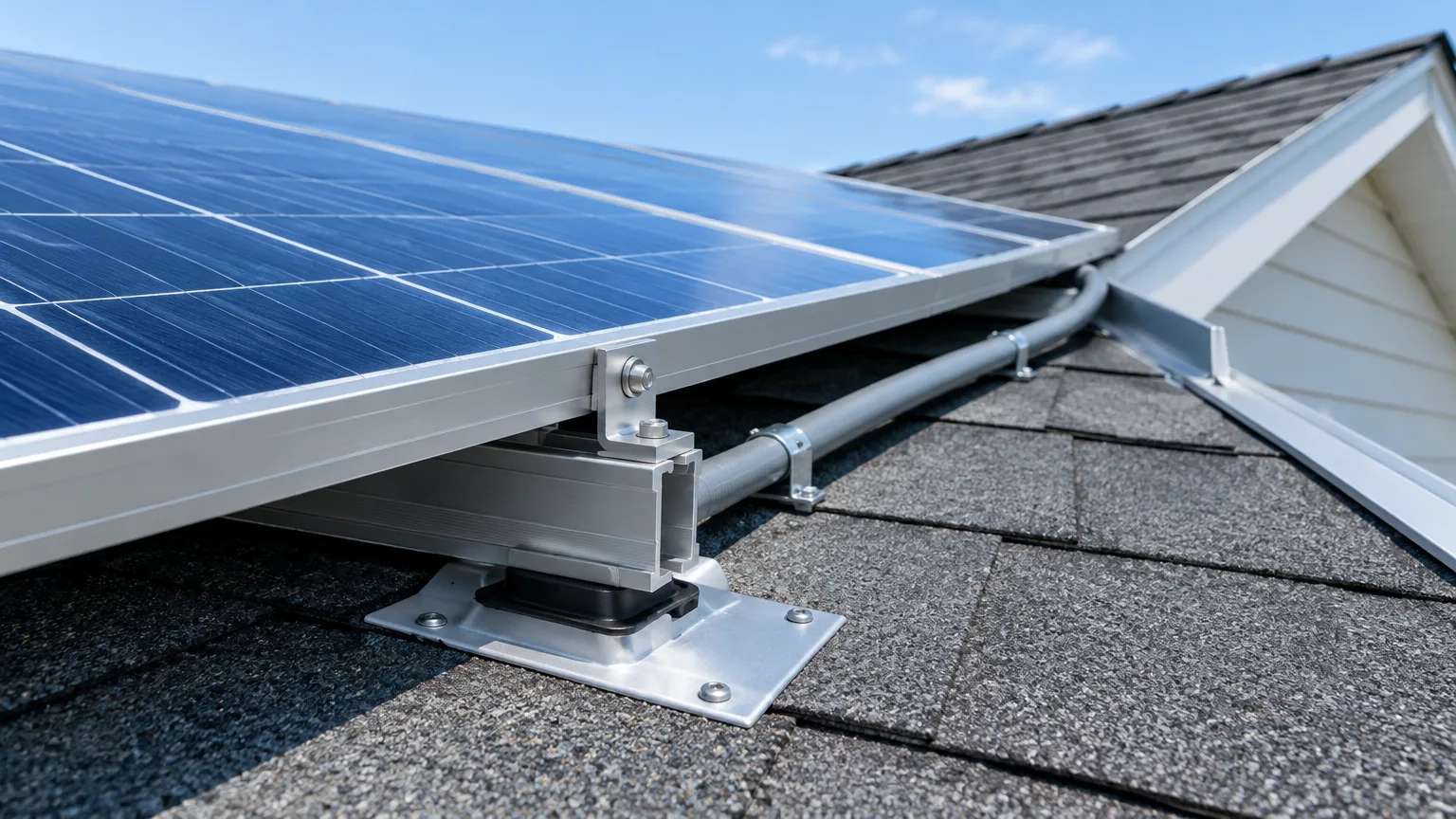
Four promises that cover different problems
| Coverage | What it addresses | Who typically stands behind it |
|---|---|---|
| Panel product warranty | A defect in the panel’s materials or manufacture | Panel manufacturer |
| Panel performance warranty | Panel power capacity falling below a specified level over time | Panel manufacturer |
| Inverter and other equipment warranties | Defects in the named inverter, optimizer, monitoring device or other component | Each component’s manufacturer |
| Installation workmanship warranty | Problems caused by the installer’s work, potentially including wiring or roof-attachment errors | Solar installer |
These coverages overlap less than they appear to. A panel manufacturer’s reference to defects in “workmanship” means workmanship in making the panel—not a guarantee that someone installed it correctly. The Federal Trade Commission advises buyers to ask separately about equipment warranties and installation workmanship, as well as any promise about how much energy the system will produce.
A panel product warranty covers defects, not every broken panel
A product warranty applies when a panel fails because of a covered manufacturing or material defect. Depending on the terms, the manufacturer may repair it, supply a comparable replacement or provide a refund. It doesn’t follow that a cracked panel after a hailstorm, damage from a falling branch or a faulty roof attachment is a covered manufacturing defect.
The written terms also decide what a successful claim is worth. Under REC’s warranty for its Alpha-series panels in the Americas, the standard product period is 20 years for the listed models, and REC can choose to repair, replace or refund the market price of an equivalent panel. Its standard warranty does not reimburse on-site labor to remove and reinstall a panel; separate enhanced coverage may apply when its conditions are met.
That distinction matters on a roof. A replacement panel is useful, but getting a crew to diagnose the fault, work safely on the array and put everything back may involve a separate bill. Before buying, ask who covers labor, travel, shipping and any required testing—not just the replacement part.
A performance warranty is about tested panel capacity
Solar panels gradually lose some power capacity. A panel performance warranty, often called a degradation guarantee, sets a floor for how much of the panel’s rated capacity it must retain at stated points in its life. It is not a promise that your utility bill will fall by a fixed amount or that the whole system will generate a set number of kilowatt-hours every year.
For example, the REC Alpha Pure-RX warranty figures specify at least 98% of nameplate power in year one, a maximum warranted decline of 0.25 percentage points per year after that, and at least 92% in year 25. For a 400-watt panel under the same type of guarantee, a 92% floor would mean 368 watts at the specified test conditions—not 368 watts whenever the sun is shining.
This is where claims are often misunderstood. A low reading in a monitoring app does not, by itself, show that a panel has crossed its degradation threshold. Weather, shade, dirt and faults elsewhere in the system can reduce the energy reaching your home. A manufacturer may require a test of the panel under defined conditions, with procedures and measurement tolerances stated in its warranty. Testing costs and who authorizes the test are worth checking before you commission one yourself.
Also separate a panel degradation guarantee from an installer’s system production guarantee. The latter, if offered, concerns the array’s energy output over a stated period and has its own adjustments and remedies. Neither promise should be assumed from the other.
The inverter has its own warranty clock
Panels produce direct-current electricity; an inverter converts it for use by the home. A string inverter serves a group of panels, while microinverters sit at individual panels. In either setup, an inverter failure can sharply reduce production even when every panel is sound.
Inverter warranties vary by model and component. SolarEdge’s Home Wave inverter is listed with a standard 12-year warranty that can be extended to 20 or 25 years. The Enphase warranty for the listed IQ8 microinverters activated on or after October 1, 2024 specifies 25 years for those units, but different periods for some other Enphase components. Check the warranty tied to your exact model and installation or activation date; don’t apply the inverter’s term to every box in the system.
Length isn’t the whole comparison. The Enphase terms cited above exclude labor to uninstall and reinstall covered products. A SolarEdge limited product warranty effective April 15, 2026 likewise excludes specified on-site labor costs unless otherwise agreed in writing. Those documents also set claim procedures and conditions. If a proposal says “25-year inverter warranty,” ask whether it includes a paid extension and who will pay the service crew.
Installation workmanship is the roof-and-wiring promise
The installer’s workmanship warranty concerns the work of putting the system on your home. It may address an improperly sealed roof penetration, a loose connection or another installation error. It is not the same as the panel maker’s product warranty, and it doesn’t necessarily cover every roof leak that appears after installation. The cause, the covered work and the contract wording matter.
Read this provision closely if roof work is likely during the system’s life. Ask who will remove and reinstall panels for a roof repair, what that service costs, and whether work by another contractor affects either warranty. Also ask how the installer’s promise interacts with any existing roof warranty. A separate mounting-hardware warranty—for example, a warranty on racking—should not be mistaken for a guarantee covering all installation work.
The installer’s ability to honor the promise matters, too. Manufacturers’ equipment warranties may remain in force even if the business closes. For a system already on a home, the Department of Energy recommends identifying the panel and inverter manufacturers if the original installer is gone and asking a qualified local installer about inspection and service.
Exclusions turn on the cause of the damage
A warranty is meant to address a covered failure, not to act as all-risk protection for the array. Equipment terms may exclude damage from improper installation, unauthorized repairs, misuse, power surges, fire, flood or other outside events. Cosmetic changes that do not affect operation may be excluded as well. Read the actual warranty rather than treating that list as universal: an exclusion in one manufacturer’s document does not automatically apply to another’s.
Storm damage is the clearest reason to keep warranties and insurance separate. If hail breaks a panel, start by documenting the damage and checking your homeowners policy rather than assuming the panel’s degradation guarantee will pay. The National Association of Insurance Commissioners advises homeowners to check with their insurer about coverage when adding solar panels; coverage and limits can differ. For a larger loss, it also helps to understand how rebuilding coverage is calculated and whether your insured amount reflects the added solar equipment.
Ownership changes deserve attention before a sale. Some equipment warranties can follow the system at its original location but require proof of the transfer or another step. A leased system or power purchase agreement is different again: the company that owns the equipment may have maintenance and repair duties set by your contract. Find out whom you must call and what, if anything, you must pay.
Build a claim file before something fails
The best time to collect warranty documents is when the installation is finished. Keep the signed installation contract, the actual manufacturer warranties, the final equipment list with model and serial numbers, purchase and installation dates, any registration confirmation, and access to the monitoring account. Save the installer’s roof and wiring documentation, too. A sales proposal describing a warranty is not a substitute for its full terms.
If production drops or you spot damage:
- Record what happened and when. Save dated monitoring screenshots, error codes, photographs taken from a safe location, and any relevant weather or roof-repair records.
- Contact the installer or service provider for diagnosis. Ask for a written finding that identifies the failed component and likely cause. Don’t climb onto the roof or disconnect electrical equipment to investigate it yourself.
- Check the applicable claim deadline and submit the notice the warranty requires. Include the serial number, proof of purchase, description of the fault and diagnostic record. Some manufacturers require authorization before a product is returned or tested.
- Get the remedy in writing. Confirm who supplies the part, who schedules the work, and who pays for labor and other charges before authorizing a repair.
When comparing proposals, put the product, performance, inverter and workmanship documents side by side. Look first at the uncovered work and the claim process, then at the headline number of years. A warranty you can document and use is worth more than a long promise whose costs and responsibilities remain unclear.